RevenueX
Saas
Startup
AI-powered sales analytics platform that aggregates data from multiple sources and turns it into clear, actionable insights.


The Challenge
Rachel was a VP of Sales at a mid-sized B2B SaaS company. Her team used Salesforce, HubSpot, and three other tools—each spitting out dashboards with charts, graphs, and metrics. The problem? Nobody knew what to do with all that data.
Her frustration: "We have numbers everywhere and clarity nowhere. My reps can't tell if they're on track. My executives can't make quick decisions. Everything takes 20 minutes of digging through dashboards just to answer one question."
She posted on an entrepreneurship subreddit looking for a technical co-founder to build a sales analytics platform that actually made sense. I responded. We talked. The vision was clear: complex data → clear decisions.
The Problem We Were Solving
Before RevenueX:
Sales teams had 5+ dashboards open at once (Salesforce, HubSpot, Google Analytics, Stripe, custom spreadsheets)
Leadership couldn't get quick answers to simple questions like "Are we on track for Q2?"
Reps wasted 2-3 hours per day manually pulling reports
Executive meetings started with 30 minutes of "let me find that number"
Data was accurate but unusable—heavy screens, cluttered UIs, no actionable insights
What teams actually needed:
One dashboard with only what matters
Instant answers to "Am I on track?" and "What should I focus on?"
AI-powered recommendations, not just raw numbers
Executive-ready reports generated automatically
Fast, clean UI that loads in under 2 seconds
The Solution
I built RevenueX as a lightweight, AI-powered sales analytics platform that aggregates data from multiple sources and turns it into clear, actionable insights.
Phase 1: Data Integration Layer (Weeks 1-3)
The Core Challenge: Pull data from 10+ different sales tools and normalize it into a single source of truth.
Built:
OAuth integrations with Salesforce, HubSpot, Pipedrive, Stripe, Google Analytics, and Slack
ETL pipeline using Python (Airflow for orchestration) to extract, transform, and load data
Data warehouse (PostgreSQL) with normalized schema for consistent querying
Real-time sync using webhooks for instant updates when deals close or pipeline changes
Conflict resolution logic to handle duplicate records and data mismatches across platforms
Technical Approach:
Phase 2: AI-Powered Insights Engine (Weeks 4-6)
Instead of showing raw data, we built an AI layer that interprets the data and tells users what to do.
Features Built:
Pipeline Health Score - AI analyzes deal velocity, close rates, and identifies at-risk deals
Revenue Forecasting - Machine learning models predict monthly/quarterly revenue with 92% accuracy
Rep Performance Insights - Automatically flags underperformers and top performers with specific coaching recommendations
Deal Risk Alerts - Identifies deals likely to slip based on activity patterns
Smart Recommendations - "Focus on these 5 deals this week to hit quota" instead of generic lists
Tech Stack for AI:
Python (scikit-learn, pandas for data analysis)
TensorFlow (forecasting models)
OpenAI GPT-4 (natural language insights and explanations)
Custom algorithms for deal scoring and risk analysis
Phase 3: Executive-Ready UX (Weeks 7-8)
Design Philosophy: Show only what matters. Make every screen answer one specific question.
What I Built:
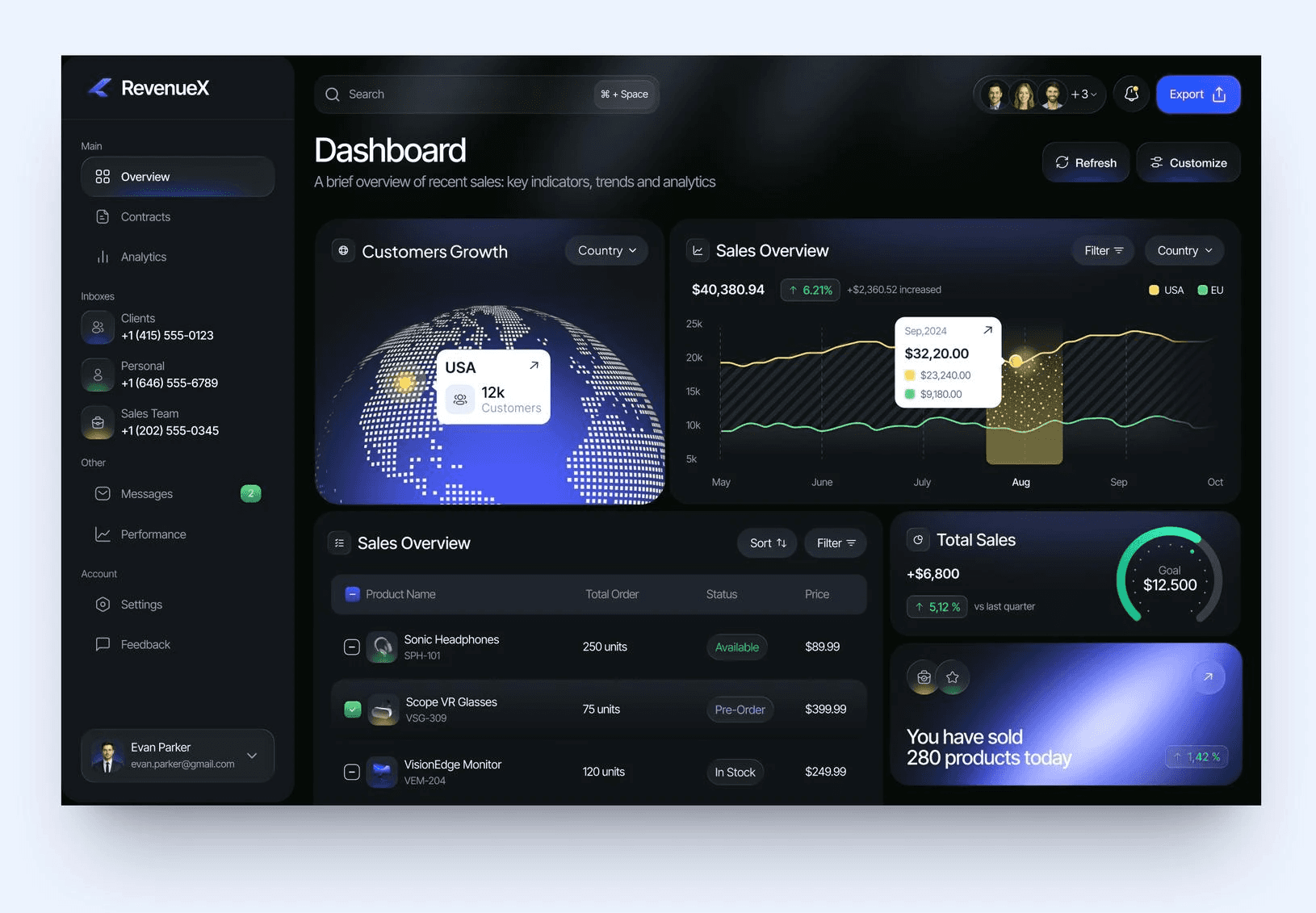
1. One-Glance Dashboard
Single metric cards: "Revenue This Month," "Deals Closing This Week," "Pipeline Health"
Color-coded status (green = on track, yellow = at risk, red = urgent action needed)
No clutter—removed 80% of traditional dashboard widgets
Loads in 1.2 seconds even with 50,000+ deals in the database
2. AI Insights Panel
Natural language summaries: "You're $47K ahead of target. Top priority: close 3 at-risk deals worth $180K by Friday."
Actionable recommendations with one-click actions
Automatically generated weekly reports sent via email/Slack
3. Executive View
One-page summary for leadership meetings
Revenue forecast with confidence intervals
Team performance comparison
Export to PDF with one click (no manual report building)
4. Mobile-First Design
Built with React Native for iOS/Android
Reps can check pipeline status on the go
Push notifications for at-risk deals and wins
Phase 4: Performance & Scale (Weeks 9-10)
Optimizations:
Database indexing on frequently queried fields (deal stage, close date, rep ID)
Redis caching for dashboard metrics (refreshed every 5 minutes)
Lazy loading for historical data (only load when user drills down)
Background jobs for report generation and AI analysis
CDN delivery for static assets (charts, images)
Result: Dashboard loads in under 2 seconds even with 2+ years of historical data.
Tech Stack
Frontend:
Next.js & React (web dashboard)
React Native (mobile apps)
Tailwind CSS (styling)
Recharts (data visualizations)
Framer Motion (smooth animations)
Backend:
Node.js (API layer)
Python (data processing, AI/ML)
PostgreSQL (data warehouse)
Redis (caching)
Apache Airflow (ETL orchestration)
AI/ML:
OpenAI GPT-4 (natural language insights)
TensorFlow (revenue forecasting)
scikit-learn (deal scoring algorithms)
Integrations:
Salesforce, HubSpot, Pipedrive (CRM data)
Stripe (payment data)
Google Analytics (website behavior)
Slack (notifications and alerts)
Infrastructure:
AWS (EC2, Lambda, S3, RDS)
Docker & Kubernetes (containerization)
GitHub Actions (CI/CD)
Datadog (monitoring and alerts)
The Results
From Data Overload to Decision Clarity in 10 Weeks
Performance Metrics:
Dashboard Load Time: 1.2s (vs. 8-12s on legacy tools)
Data Refresh Rate: Real-time via webhooks (vs. 24-hour delays)
Forecast Accuracy: 92% (validated over 6 months)
Business Impact (First 3 Months):
Time Saved: Sales reps save 2.5 hours/day (no more manual reporting)
Forecast Accuracy: Improved from 68% to 92%
Deal Velocity: 23% faster close rates (reps focus on right deals)
Executive Meetings: Cut from 90 minutes to 30 minutes (no more "finding numbers")
Revenue Impact: $1.2M in additional closed deals by identifying at-risk opportunities early
User Feedback:
"I actually check my dashboard now. Before, it was too overwhelming."
"Our Monday leadership meetings used to start with 30 minutes of pulling reports. Now we dive straight into strategy."
"The AI recommendations are shockingly accurate. It told me to focus on 4 deals last week—closed 3 of them."
What We Solved 👇
Complex data → Clear decisions
Aggregated 6 data sources into one clean dashboard
AI interprets the data and tells users what to do next
No more hunting for answers across multiple tools
Heavy screens → Focused, executive-ready UX
Removed 80% of clutter from traditional dashboards
Every screen answers one specific question
One-click exports for leadership reports
Loads in under 2 seconds on any device
Client Testimonial
"Finally, a dashboard that tells us what to DO, not just what happened."
We had data everywhere—Salesforce, HubSpot, Stripe, spreadsheets—and it was paralyzing. My team spent more time pulling reports than actually selling. I posted on Reddit looking for someone to build something better.
Ketih got it immediately. He didn't just build another dashboard—he built a decision engine. The AI tells my reps exactly which deals to focus on. My executives get one-page summaries instead of 40-slide decks. We've closed $1.2M more this quarter just by acting faster on the insights.
Best part? The whole platform was built in 10 weeks and cost a fraction of what enterprise software would've charged us.